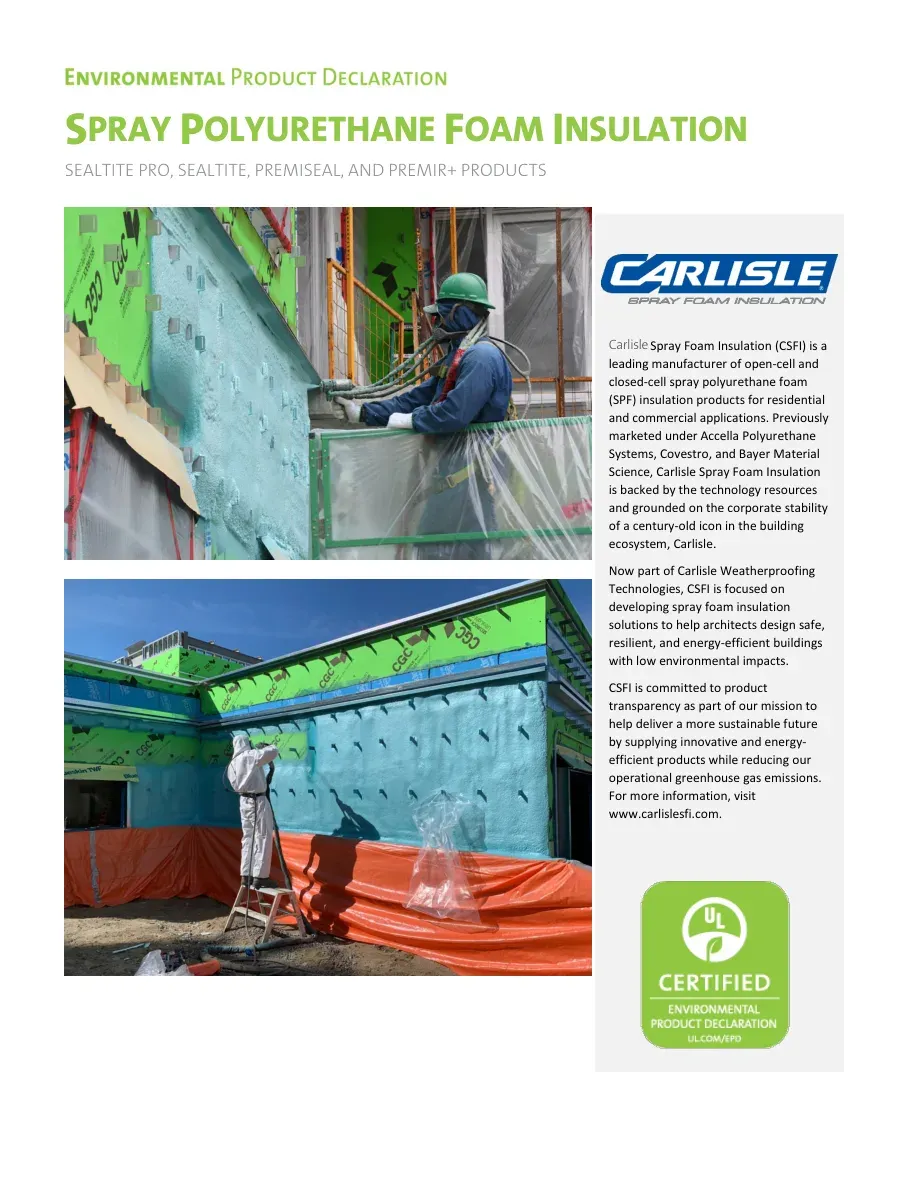
SPRAY POLYURETHANE FOAM INSULATION SEALTITE PRO, SEALTITE, PREMISEAL, AND PREMIR+ PRODUCTS Carlisle Spray Foam Insulation (CSFI) is a leading manufacturer of open-cell and closed-cell spray polyurethane foam (SPF) insulation products for residential and commercial applications. Previously marketed under Accella Polyurethane Systems, Covestro, and Bayer Material Science, Carlisle Spray Foam Insulation is backed by the technology resources and grounded on the corporate stability of a century-old icon in the building ecosystem, Carlisle. Now part of Carlisle Weatherproofing Technologies, CSFI is focused on developing spray foam insulation solutions to help architects design safe, resilient, and energy-efficient buildings with low environmental impacts. CSFI is committed to product transparency as part of our mission to help deliver a more sustainable future by supplying innovative and energy-efficient products while reducing our operational greenhouse gas emissions. For more information, visit www.carlislesfi.com.
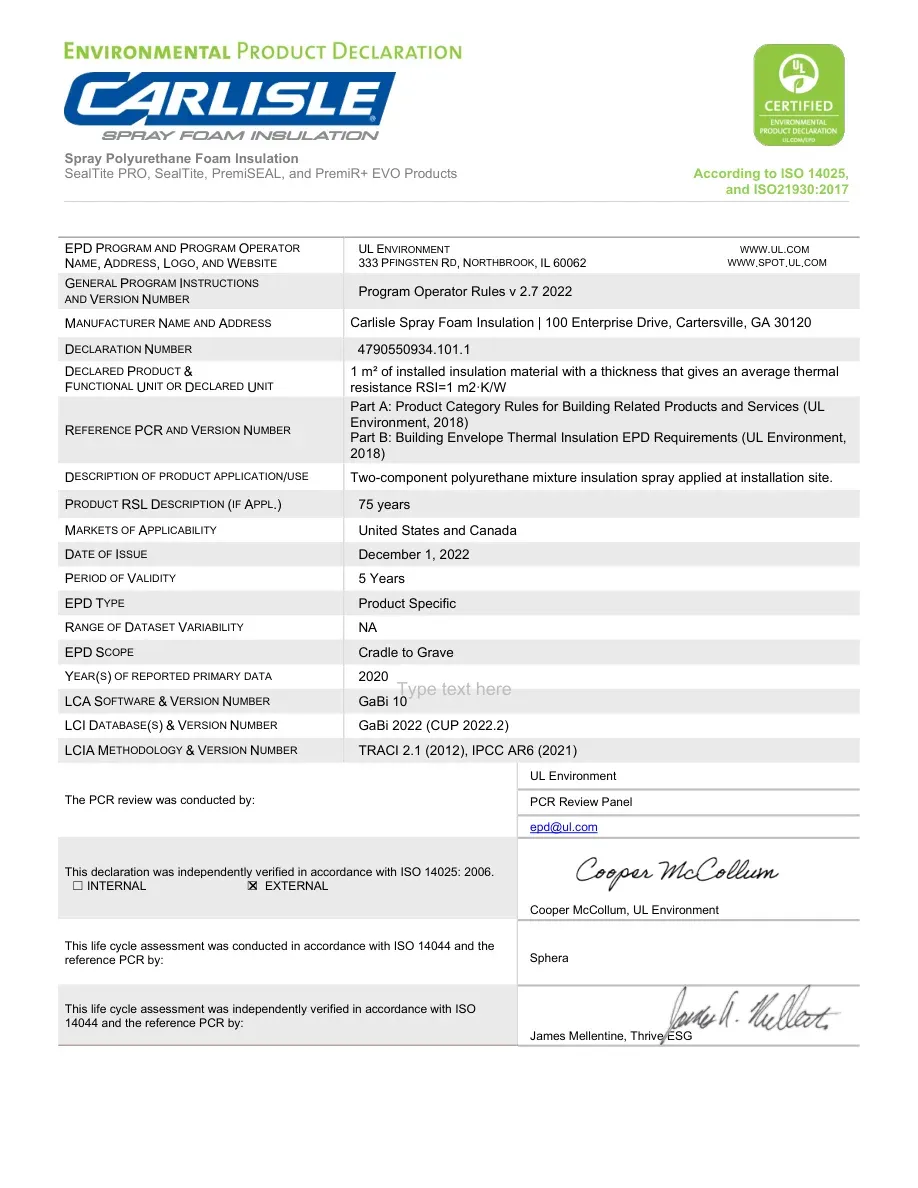
Spray Polyurethane Foam Insulation SealTite PRO, SealTite, PremiSEAL, and PremiR+ EVO Products According to ISO 14025,and ISO21930:2017EPD PROGRAM AND PROGRAM OPERATORNAME, ADDRESS, LOGO, AND WEBSITE UL ENVIRONMENT WWW.UL.COM 333 PFINGSTEN RD, NORTHBROOK, IL 60062 WWW.SPOT.UL.COM GENERAL PROGRAM INSTRUCTIONS AND VERSION NUMBER Program Operator Rules v 2.7 2022 MANUFACTURER NAME AND ADDRESS Carlisle Spray Foam Insulation | 100 Enterprise Drive, Cartersville, GA 30120 DECLARATION NUMBER 4790550934.101.1 DECLARED PRODUCT & FUNCTIONAL UNIT OR DECLARED UNIT 1 m² of installed insulation material with a thickness that gives an average thermal resistance RSI=1 m2·K/W REFERENCE PCR AND VERSION NUMBER Part A: Product Category Rules for Building Related Products and Services (UL Environment, 2018) Part B: Building Envelope Thermal Insulation EPD Requirements (UL Environment, 2018) DESCRIPTION OF PRODUCT APPLICATION/USE Two-component polyurethane mixture insulation spray applied at installation site. PRODUCT RSL DESCRIPTION (IF APPL.) 75 years MARKETS OF APPLICABILITY United States and Canada DATE OF ISSUE December 1, 2022 PERIOD OF VALIDITY 5 Years EPD TYPE Product Specific RANGE OF DATASET VARIABILITY NA EPD SCOPE Cradle to Grave YEAR(S) OF REPORTED PRIMARY DATA 2020 LCA SOFTWARE & VERSION NUMBER GaBi 10 LCI DATABASE(S) & VERSION NUMBER GaBi 2022 (CUP 2022.2) LCIA METHODOLOGY & VERSION NUMBER TRACI 2.1 (2012), IPCC AR6 (2021) The PCR review was conducted by: UL Environment PCR Review Panel epd@ul.com This declaration was independently verified in accordance with ISO 14025: 2006. ☐INTERNAL☐EXTERNALCooper McCollum, UL Environment This life cycle assessment was conducted in accordance with ISO 14044 and the reference PCR by: SpheraThis life cycle assessment was independently verified in accordance with ISO 14044 and the reference PCR by: James Mellentine, Thrive ESG Type text here
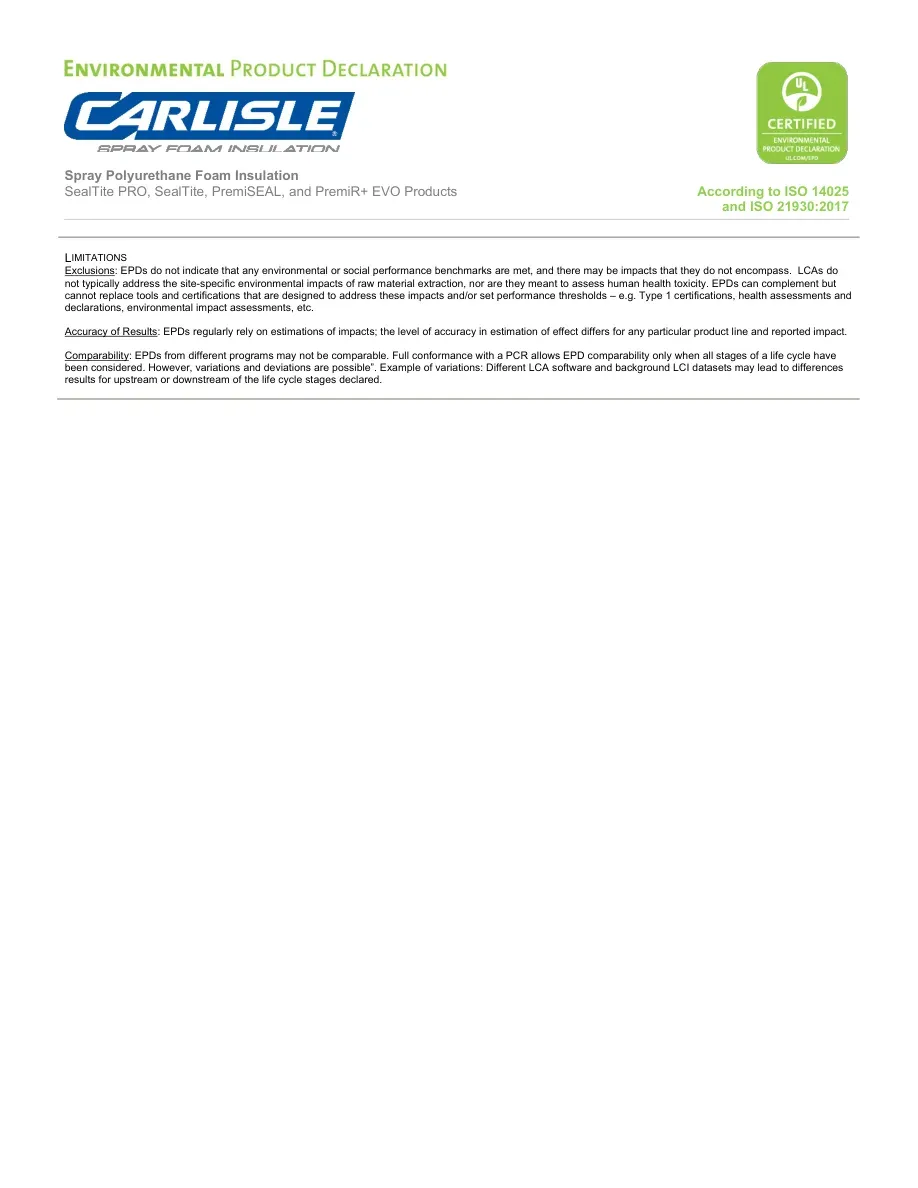
Spray Polyurethane Foam Insulation SealTite PRO, SealTite, PremiSEAL, and PremiR+ EVO Products According to ISO 14025and ISO 21930:2017LIMITATIONS Exclusions: EPDs do not indicate that any environmental or social performance benchmarks are met, and there may be impacts that they do not encompass. LCAs do not typically address the site-specific environmental impacts of raw material extraction, nor are they meant to assess human health toxicity. EPDs can complement but cannot replace tools and certifications that are designed to address these impacts and/or set performance thresholds – e.g. Type 1 certifications, health assessments and declarations, environmental impact assessments, etc. Accuracy of Results: EPDs regularly rely on estimations of impacts; the level of accuracy in estimation of effect differs for any particular product line and reported impact. Comparability: EPDs from different programs may not be comparable. Full conformance with a PCR allows EPD comparability only when all stages of a life cycle have been considered. However, variations and deviations are possible”. Example of variations: Different LCA software and background LCI datasets may lead to differences results for upstream or downstream of the life cycle stages declared.
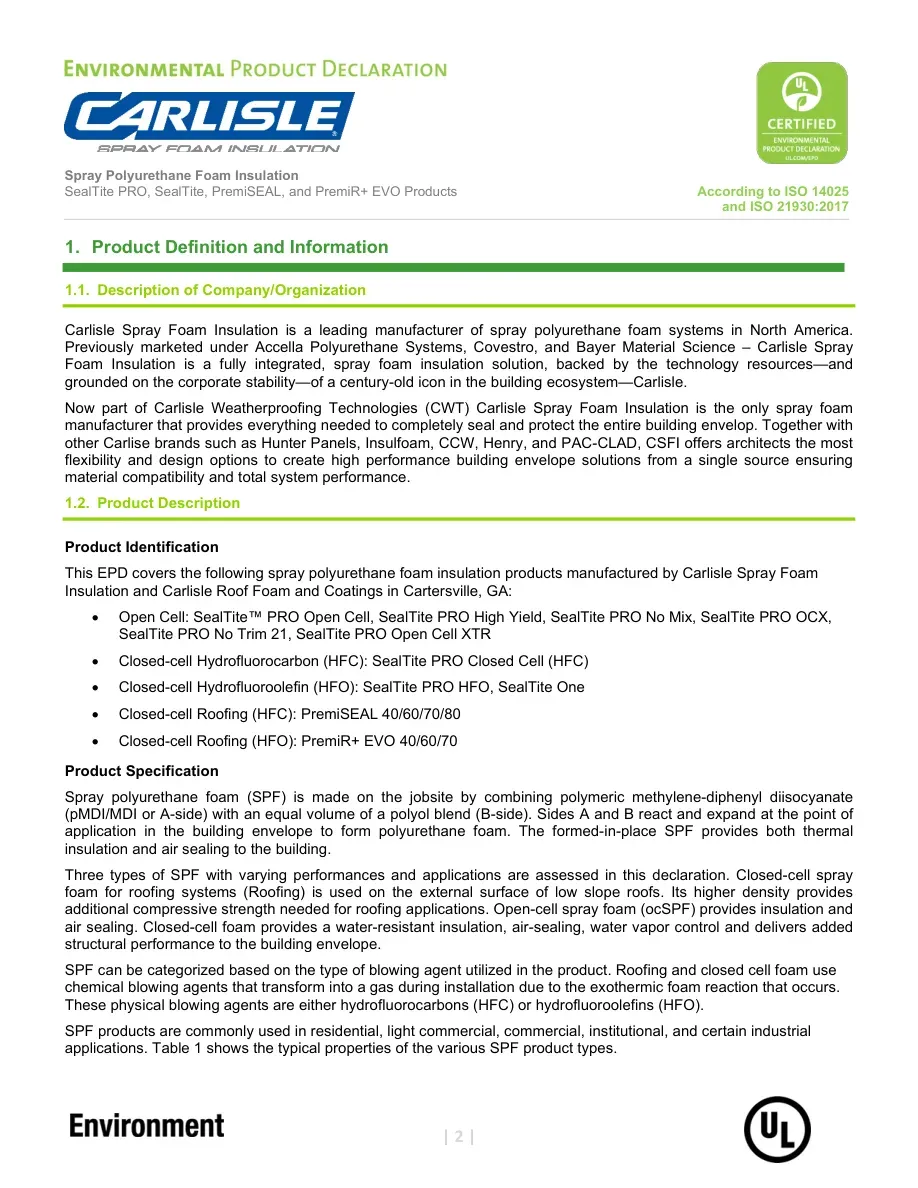
| 2 | Spray Polyurethane Foam Insulation SealTite PRO, SealTite, PremiSEAL, and PremiR+ EVO Products According to ISO 14025and ISO 21930:20171. Product Definition and Information1.1. Description of Company/Organization Carlisle Spray Foam Insulation is a leading manufacturer of spray polyurethane foam systems in North America. Previously marketed under Accella Polyurethane Systems, Covestro, and Bayer Material Science – Carlisle Spray Foam Insulation is a fully integrated, spray foam insulation solution, backed by the technology resources—and grounded on the corporate stability—of a century-old icon in the building ecosystem—Carlisle. Now part of Carlisle Weatherproofing Technologies (CWT) Carlisle Spray Foam Insulation is the only spray foam manufacturer that provides everything needed to completely seal and protect the entire building envelop. Together with other Carlise brands such as Hunter Panels, Insulfoam, CCW, Henry, and PAC-CLAD, CSFI offers architects the most flexibility and design options to create high performance building envelope solutions from a single source ensuring material compatibility and total system performance. 1.2. Product Description Product Identification This EPD covers the following spray polyurethane foam insulation products manufactured by Carlisle Spray Foam Insulation and Carlisle Roof Foam and Coatings in Cartersville, GA: •Open Cell: SealTite™ PRO Open Cell, SealTite PRO High Yield, SealTite PRO No Mix, SealTite PRO OCX,SealTite PRO No Trim 21, SealTite PRO Open Cell XTR•Closed-cell Hydrofluorocarbon (HFC): SealTite PRO Closed Cell (HFC)•Closed-cell Hydrofluoroolefin (HFO): SealTite PRO HFO, SealTite One•Closed-cell Roofing (HFC): PremiSEAL 40/60/70/80•Closed-cell Roofing (HFO): PremiR+ EVO 40/60/70Product Specification Spray polyurethane foam (SPF) is made on the jobsite by combining polymeric methylene-diphenyl diisocyanate (pMDI/MDI or A-side) with an equal volume of a polyol blend (B-side). Sides A and B react and expand at the point of application in the building envelope to form polyurethane foam. The formed-in-place SPF provides both thermal insulation and air sealing to the building. Three types of SPF with varying performances and applications are assessed in this declaration. Closed-cell spray foam for roofing systems (Roofing) is used on the external surface of low slope roofs. Its higher density provides additional compressive strength needed for roofing applications. Open-cell spray foam (ocSPF) provides insulation and air sealing. Closed-cell foam provides a water-resistant insulation, air-sealing, water vapor control and delivers added structural performance to the building envelope. SPF can be categorized based on the type of blowing agent utilized in the product. Roofing and closed cell foam use chemical blowing agents that transform into a gas during installation due to the exothermic foam reaction that occurs. These physical blowing agents are either hydrofluorocarbons (HFC) or hydrofluoroolefins (HFO). SPF products are commonly used in residential, light commercial, commercial, institutional, and certain industrial applications. Table 1 shows the typical properties of the various SPF product types.
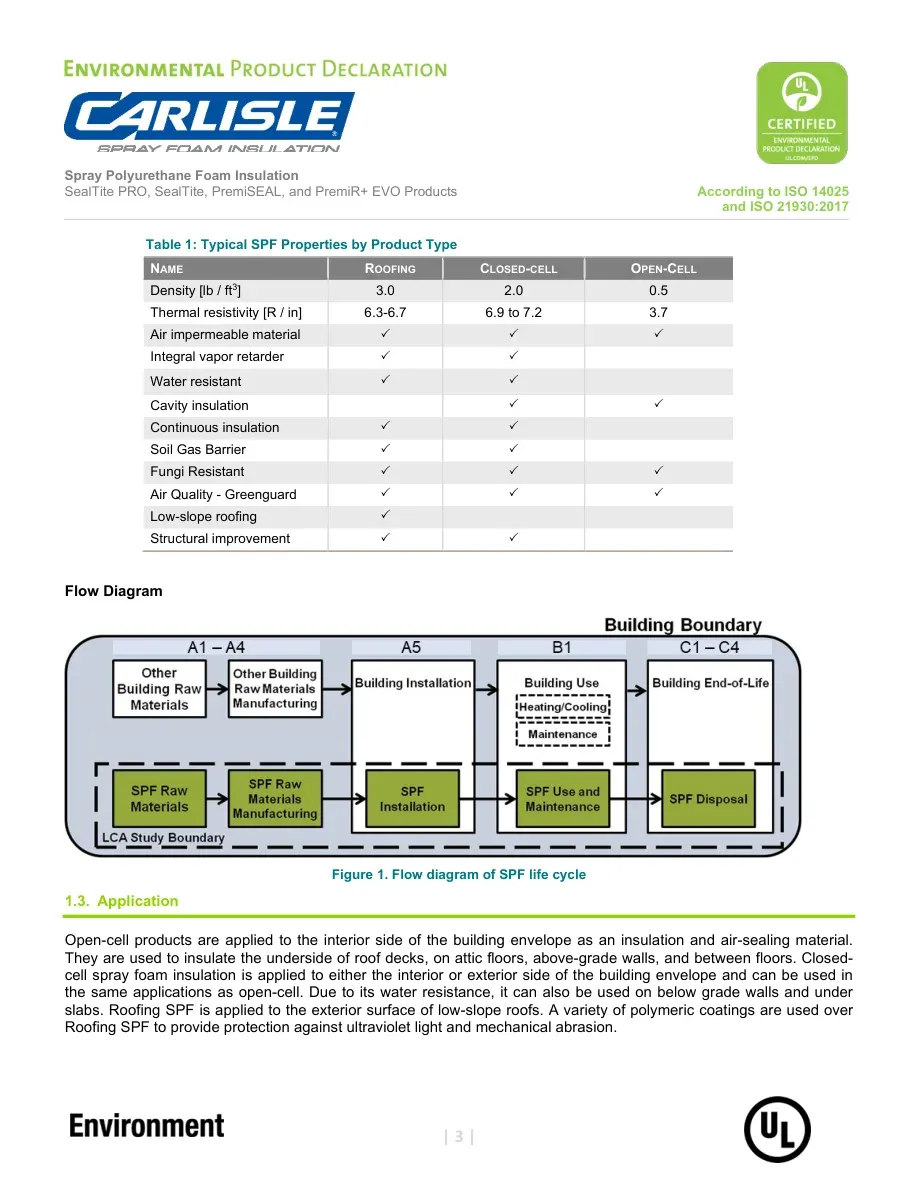
| 3 | Spray Polyurethane Foam Insulation SealTite PRO, SealTite, PremiSEAL, and PremiR+ EVO Products According to ISO 14025and ISO 21930:2017Table 1: Typical SPF Properties by Product Type NAME ROOFING CLOSED-CELL OPEN-CELL Density [lb / ft3] 3.0 2.0 0.5 Thermal resistivity [R / in] 6.3-6.7 6.9 to 7.2 3.7 Air impermeable material Integral vapor retarder Water resistant Cavity insulation Continuous insulation Soil Gas Barrier Fungi Resistant Air Quality - Greenguard Low-slope roofing Structural improvement Flow Diagram Figure 1. Flow diagram of SPF life cycle 1.3. Application Open-cell products are applied to the interior side of the building envelope as an insulation and air-sealing material. They are used to insulate the underside of roof decks, on attic floors, above-grade walls, and between floors. Closed-cell spray foam insulation is applied to either the interior or exterior side of the building envelope and can be used in the same applications as open-cell. Due to its water resistance, it can also be used on below grade walls and under slabs. Roofing SPF is applied to the exterior surface of low-slope roofs. A variety of polymeric coatings are used over Roofing SPF to provide protection against ultraviolet light and mechanical abrasion.
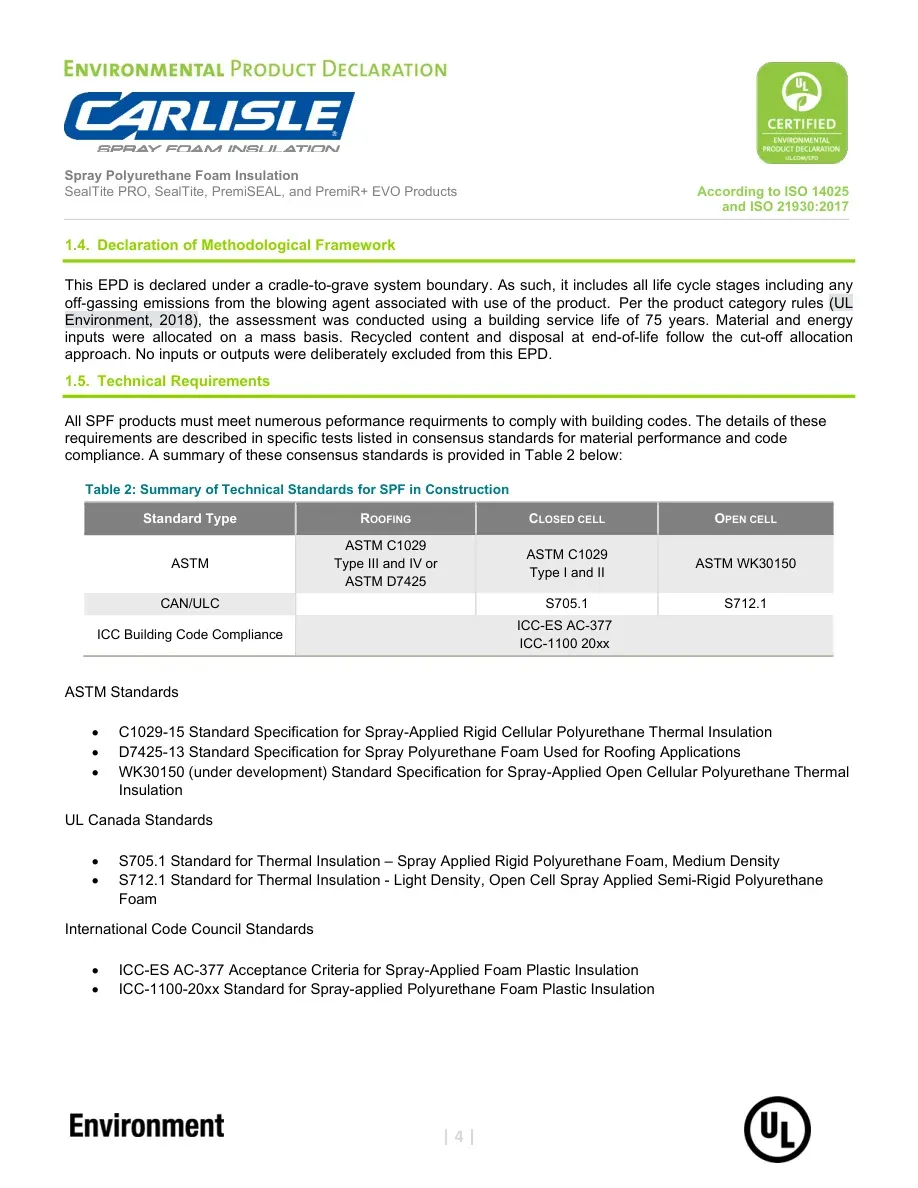
| 4 | Spray Polyurethane Foam Insulation SealTite PRO, SealTite, PremiSEAL, and PremiR+ EVO Products According to ISO 14025and ISO 21930:20171.4. Declaration of Methodological Framework This EPD is declared under a cradle-to-grave system boundary. As such, it includes all life cycle stages including any off-gassing emissions from the blowing agent associated with use of the product. Per the product category rules (UL Environment, 2018), the assessment was conducted using a building service life of 75 years. Material and energy inputs were allocated on a mass basis. Recycled content and disposal at end-of-life follow the cut-off allocation approach. No inputs or outputs were deliberately excluded from this EPD. 1.5. Technical Requirements All SPF products must meet numerous peformance requirments to comply with building codes. The details of these requirements are described in specific tests listed in consensus standards for material performance and code compliance. A summary of these consensus standards is provided in Table 2 below: Table 2: Summary of Technical Standards for SPF in Construction Standard Type ROOFING CLOSED CELL OPEN CELL ASTM ASTM C1029 Type III and IV or ASTM D7425 ASTM C1029 Type I and II ASTM WK30150 CAN/ULC S705.1 S712.1 ICC Building Code Compliance ICC-ES AC-377 ICC-1100 20xx ASTM Standards •C1029-15 Standard Specification for Spray-Applied Rigid Cellular Polyurethane Thermal Insulation•D7425-13 Standard Specification for Spray Polyurethane Foam Used for Roofing Applications•WK30150 (under development) Standard Specification for Spray-Applied Open Cellular Polyurethane ThermalInsulationUL Canada Standards •S705.1 Standard for Thermal Insulation – Spray Applied Rigid Polyurethane Foam, Medium Density•S712.1 Standard for Thermal Insulation - Light Density, Open Cell Spray Applied Semi-Rigid PolyurethaneFoamInternational Code Council Standards •ICC-ES AC-377 Acceptance Criteria for Spray-Applied Foam Plastic Insulation•ICC-1100-20xx Standard for Spray-applied Polyurethane Foam Plastic Insulation
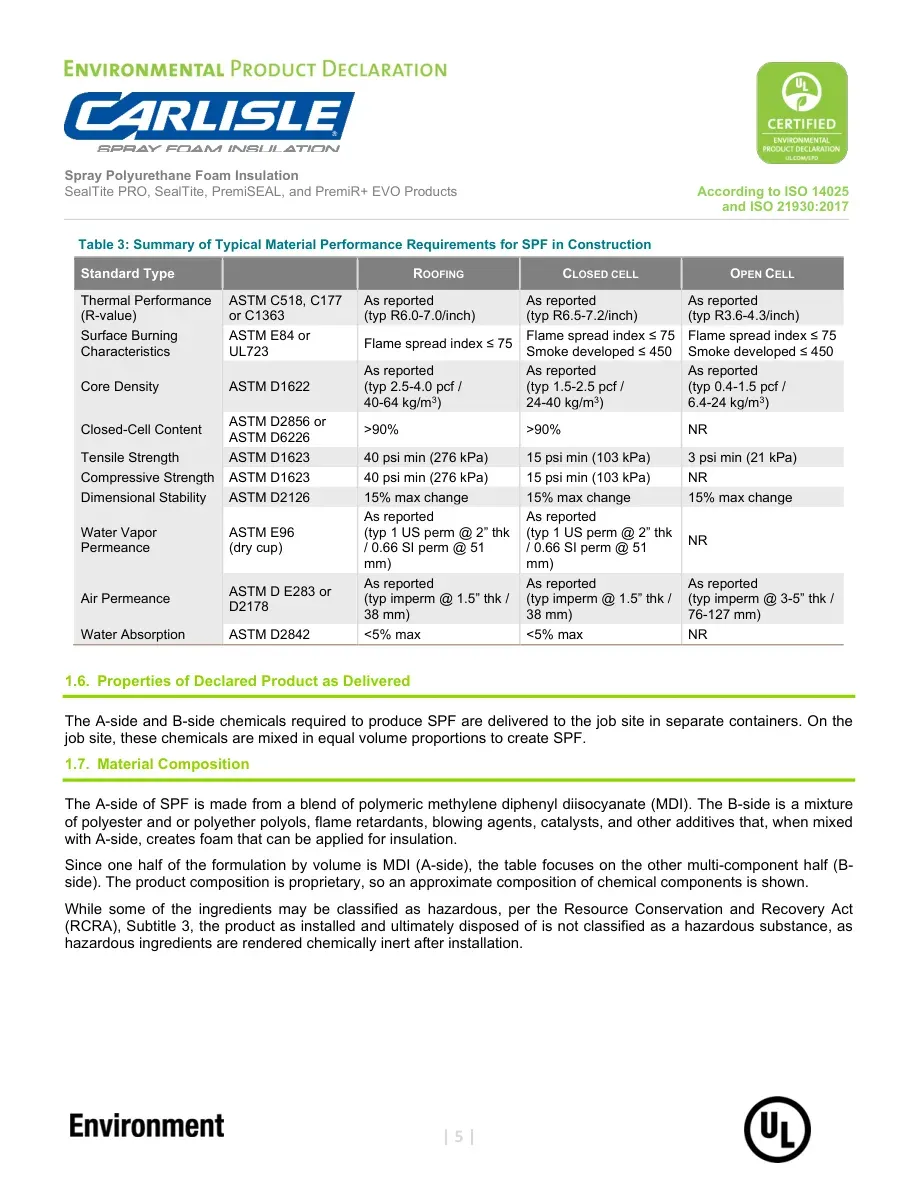
| 5 | Spray Polyurethane Foam Insulation SealTite PRO, SealTite, PremiSEAL, and PremiR+ EVO Products According to ISO 14025and ISO 21930:2017Table 3: Summary of Typical Material Performance Requirements for SPF in Construction Standard Type ROOFING CLOSED CELL OPEN CELL Thermal Performance (R-value) ASTM C518, C177 or C1363 As reported (typ R6.0-7.0/inch) As reported (typ R6.5-7.2/inch) As reported (typ R3.6-4.3/inch) Surface Burning Characteristics ASTM E84 or UL723 Flame spread index ≤ 75 Flame spread index ≤ 75 Smoke developed ≤ 450 Flame spread index ≤ 75 Smoke developed ≤ 450 Core Density ASTM D1622 As reported (typ 2.5-4.0 pcf / 40-64 kg/m3) As reported (typ 1.5-2.5 pcf / 24-40 kg/m3) As reported (typ 0.4-1.5 pcf / 6.4-24 kg/m3) Closed-Cell Content ASTM D2856 or ASTM D6226 >90% >90% NR Tensile Strength ASTM D1623 40 psi min (276 kPa) 15 psi min (103 kPa) 3 psi min (21 kPa) Compressive Strength ASTM D1623 40 psi min (276 kPa) 15 psi min (103 kPa) NR Dimensional Stability ASTM D2126 15% max change 15% max change 15% max change Water Vapor Permeance ASTM E96 (dry cup) As reported (typ 1 US perm @ 2” thk / 0.66 SI perm @ 51 mm) As reported (typ 1 US perm @ 2” thk / 0.66 SI perm @ 51 mm) NR Air Permeance ASTM D E283 or D2178 As reported (typ imperm @ 1.5” thk / 38 mm) As reported (typ imperm @ 1.5” thk / 38 mm) As reported (typ imperm @ 3-5” thk / 76-127 mm) Water Absorption ASTM D2842 <5% max <5% max NR 1.6. Properties of Declared Product as Delivered The A-side and B-side chemicals required to produce SPF are delivered to the job site in separate containers. On the job site, these chemicals are mixed in equal volume proportions to create SPF. 1.7. Material Composition The A-side of SPF is made from a blend of polymeric methylene diphenyl diisocyanate (MDI). The B-side is a mixture of polyester and or polyether polyols, flame retardants, blowing agents, catalysts, and other additives that, when mixed with A-side, creates foam that can be applied for insulation. Since one half of the formulation by volume is MDI (A-side), the table focuses on the other multi-component half (B-side). The product composition is proprietary, so an approximate composition of chemical components is shown. While some of the ingredients may be classified as hazardous, per the Resource Conservation and Recovery Act (RCRA), Subtitle 3, the product as installed and ultimately disposed of is not classified as a hazardous substance, as hazardous ingredients are rendered chemically inert after installation.
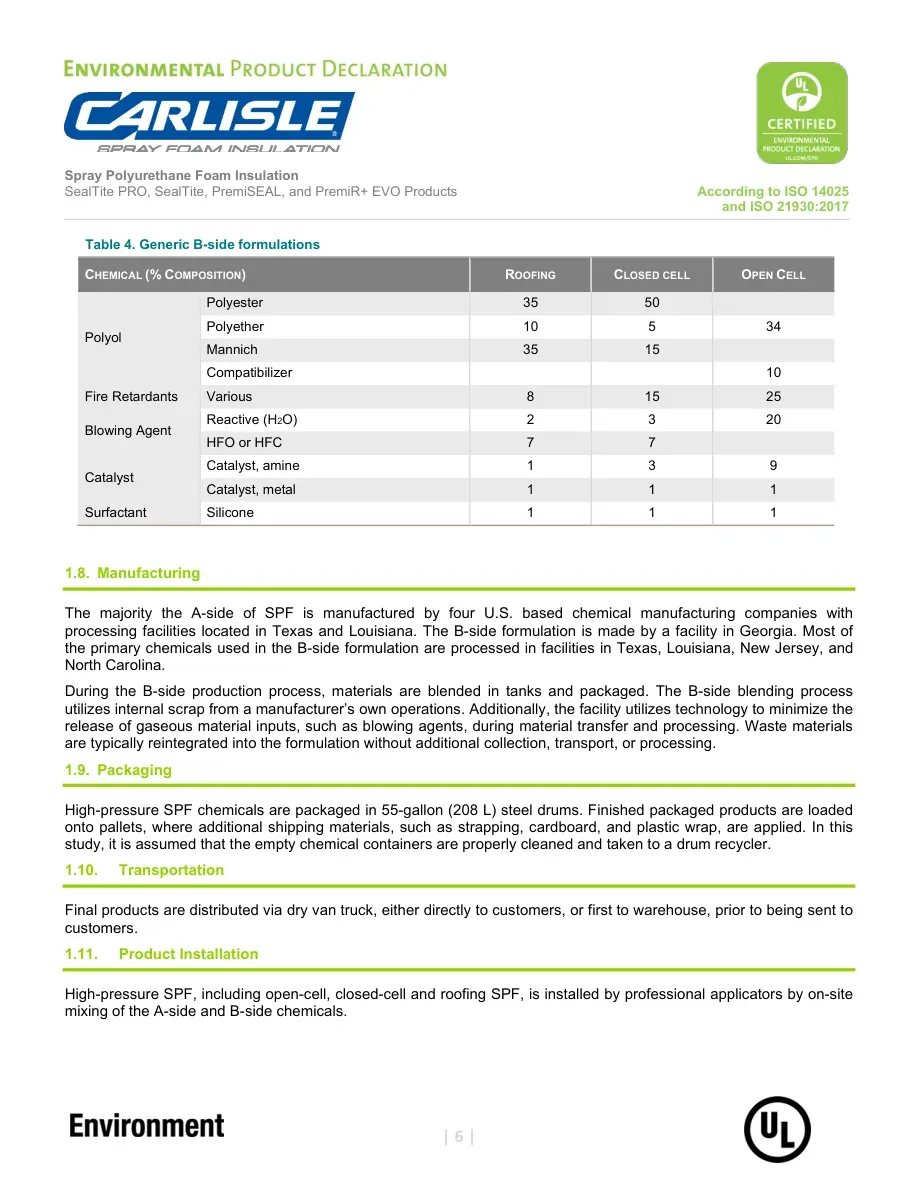
| 6 | Spray Polyurethane Foam Insulation SealTite PRO, SealTite, PremiSEAL, and PremiR+ EVO Products According to ISO 14025and ISO 21930:2017Table 4. Generic B-side formulations CHEMICAL (% COMPOSITION) ROOFING CLOSED CELL OPEN CELL Polyol Polyester 35 50 Polyether 10 5 34 Mannich 35 15 Compatibilizer 10 Fire Retardants Various 8 15 25 Blowing Agent Reactive (H2O) 2 3 20 HFO or HFC 7 7 Catalyst Catalyst, amine 1 3 9 Catalyst, metal 1 1 1 Surfactant Silicone 1 1 1 1.8. Manufacturing The majority the A-side of SPF is manufactured by four U.S. based chemical manufacturing companies with processing facilities located in Texas and Louisiana. The B-side formulation is made by a facility in Georgia. Most of the primary chemicals used in the B-side formulation are processed in facilities in Texas, Louisiana, New Jersey, and North Carolina. During the B-side production process, materials are blended in tanks and packaged. The B-side blending process utilizes internal scrap from a manufacturer’s own operations. Additionally, the facility utilizes technology to minimize the release of gaseous material inputs, such as blowing agents, during material transfer and processing. Waste materials are typically reintegrated into the formulation without additional collection, transport, or processing. 1.9. Packaging High-pressure SPF chemicals are packaged in 55-gallon (208 L) steel drums. Finished packaged products are loaded onto pallets, where additional shipping materials, such as strapping, cardboard, and plastic wrap, are applied. In this study, it is assumed that the empty chemical containers are properly cleaned and taken to a drum recycler. 1.10. Transportation Final products are distributed via dry van truck, either directly to customers, or first to warehouse, prior to being sent to customers. 1.11. Product Installation High-pressure SPF, including open-cell, closed-cell and roofing SPF, is installed by professional applicators by on-site mixing of the A-side and B-side chemicals.
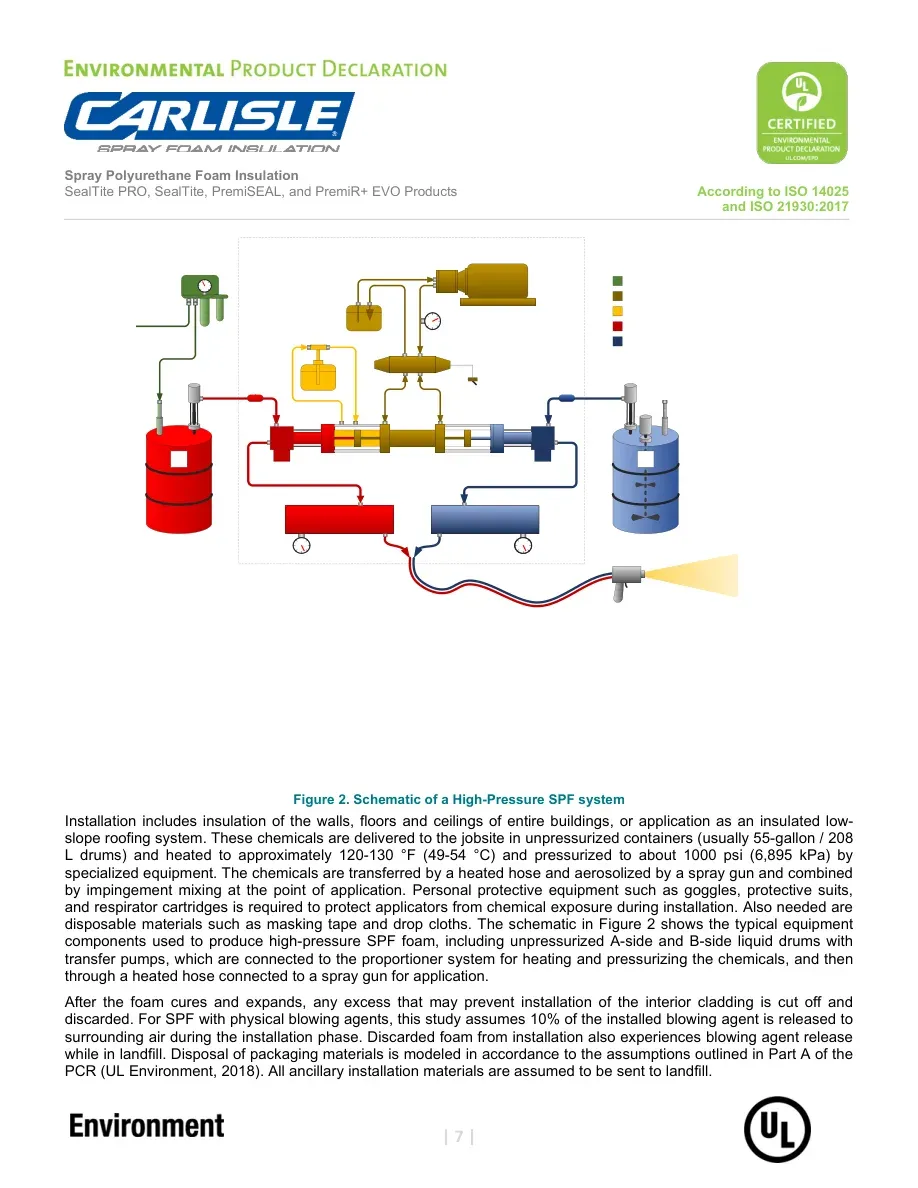
| 7 | Spray Polyurethane Foam Insulation SealTite PRO, SealTite, PremiSEAL, and PremiR+ EVO Products According to ISO 14025and ISO 21930:2017 Figure 2. Schematic of a High-Pressure SPF system Installation includes insulation of the walls, floors and ceilings of entire buildings, or application as an insulated low-slope roofing system. These chemicals are delivered to the jobsite in unpressurized containers (usually 55-gallon / 208 L drums) and heated to approximately 120-130 °F (49-54 °C) and pressurized to about 1000 psi (6,895 kPa) by specialized equipment. The chemicals are transferred by a heated hose and aerosolized by a spray gun and combined by impingement mixing at the point of application. Personal protective equipment such as goggles, protective suits, and respirator cartridges is required to protect applicators from chemical exposure during installation. Also needed are disposable materials such as masking tape and drop cloths. The schematic in Figure 2 shows the typical equipment components used to produce high-pressure SPF foam, including unpressurized A-side and B-side liquid drums with transfer pumps, which are connected to the proportioner system for heating and pressurizing the chemicals, and then through a heated hose connected to a spray gun for application. After the foam cures and expands, any excess that may prevent installation of the interior cladding is cut off and discarded. For SPF with physical blowing agents, this study assumes 10% of the installed blowing agent is released to surrounding air during the installation phase. Discarded foam from installation also experiences blowing agent release while in landfill. Disposal of packaging materials is modeled in accordance to the assumptions outlined in Part A of the PCR (UL Environment, 2018). All ancillary installation materials are assumed to be sent to landfill.
| 8 | Spray Polyurethane Foam Insulation SealTite PRO, SealTite, PremiSEAL, and PremiR+ EVO Products According to ISO 14025and ISO 21930:20171.12. Use As this study only looks at the life cycle of spray foam insulation, and not the building, the use phase only contains the emissions of any chemicals off-gassed from the foam. This study assumes 24% of the original chemical blowing agent is off-gassed over a 75-year lifetime (Honeywell International). 1.13. Reference Service Life and Estimated Building Service Life Lorem The reference service life (RSL) for SPF is the life of the building or 75 years. Additional information is provided in Table 7. 1.14. Disposal When the building is decommissioned, it is assumed that only manual labor is involved to remove the foam. Wastes are assumed to be transported 100 miles (160 km) to the disposal site. The spray foam is assumed to be landfilled at end-of-life, as is typical for construction and demolition waste in the US. This study assumes 16% of the original physical blowing agent is emitted at this stage in the life cycle. It is further assumed the spray foam is inert in the landfill and 50% of the blowing agent remains in the product after disposal (Kjeldsen & Jensen, 2001). 2. Life Cycle Assessment Background Information 2.1. Functional or Declared Unit The product function is providing insulation to buildings. Accordingly, the functional unit for the study is 1 m² of installed insulation material with a thickness that gives an average thermal resistance of RSI=1m2·K/W (In imperial units, RSI=1 is equivalent to R = 5.68 h·ft²·°F/Btu) with a building service life of 75 years (packaging included). 2.2. System Boundary The study uses a cradle-to-grave system boundary. As such, it includes upstream processing and production of materials and energy resources needed to produce SPF, transport of materials (all chemical inputs for production and packaging) to SPF formulation sites, formulation of SPF components, transport of the components to the installation site, installation of insulation, removal and transport of insulation to disposal site, and end-of-life-disposal. Building energy savings from the use of insulation are excluded from this analysis. 2.3. Estimates and Assumptions The material and energy inputs and outputs were modeled according to data provided by the representative site, while the electricity grid and natural gas mix were chosen based on the location of the production facility. Lastly, this study assumes 50% of blowing agent consumed in the production of the formulation is eventually emitted, 10% during installation, 24% during its lifetime in the building, and 16% during end-of-life. The remaining 50% remains in the product (Honeywell International) (Kjeldsen & Jensen, 2001). 2.4. Cut-off Criteria The cut-off criteria for including or excluding materials, energy and emissions data of the study are as follows: – Mass – If a flow is less than 1% of the cumulative mass of the model it may be excluded, providing its environmental relevance is not a concern.
| 9 | Spray Polyurethane Foam Insulation SealTite PRO, SealTite, PremiSEAL, and PremiR+ EVO Products According to ISO 14025and ISO 21930:2017– Energy – If a flow is less than 1% of the cumulative energy of the model it may be excluded, providing its environmental relevance is not a concern. – Environmental relevance – If a flow meets the above criteria for exclusion yet is thought to potentially have a significant environmental impact, it was included. Material flows which leave the system (emissions) and whose environmental impact is greater than 1% of the total of an impact category that has been considered in the assessment must be covered. This judgment was made based on experience and documented as necessary. Packaging of incoming raw materials (e.g. pallets, totes, super-sacks) are excluded as they represent less than 1% of the product mass. Capital goods and infrastructure required to produce and install SPF (e.g. batch mixers, spraying equipment) are presumed to produce millions of units over the course of their life, so impact of a single functional unit attributed to these equipment is assumed to be negligible; therefore, capital goods and infrastructure were excluded from this study. No known flows are deliberately excluded from this EPD. 2.5. Data Sources The LCA model was created using the GaBi Software system for life cycle engineering, developed by Sphera Solutions. The GaBi 2022.2 LCI database provides the life cycle inventory data for several of the raw and process materials obtained from the background system. 2.6. Data Quality A variety of tests and checks were performed by the LCA practitioner throughout the project to ensure high quality of the completed LCA. Checks included an extensive review of the LCA model as well as the background data used. Temporal coverage The data are intended to represent spray polyurethane foam production during the 2020 calendar year. As such, CSFI provided primary data for 12 consecutive months during the 2020 calendar year. Geographical coverage This background LCA represents CSFI’s products produced in the United States. Primary data are representative of these countries. Regionally specific datasets were used to represent each manufacturing location’s energy consumption. Proxy datasets were used as needed for raw material inputs to address lack of data for a specific material or for a specific geographical region. These proxy datasets were chosen for their technological representativeness of the actual materials. Technological coverage Data on material composition were collected directly from CSFI. Manufacturing data were provided by CSFI for the Open Cell, Closed-Cell (HFC and HFO) and Roofing (HFC and HFO) products. Waste, emissions, and energy use are calculated from reported annual production during the reference year. 2.7. Period under Review Primary data collected represent production during the 2020 calendar year. This analysis is intended to represent production in 2020. 2.8. Allocation The cut-off allocation approach is adopted in the case of any post-consumer and post-industrial recycled content,
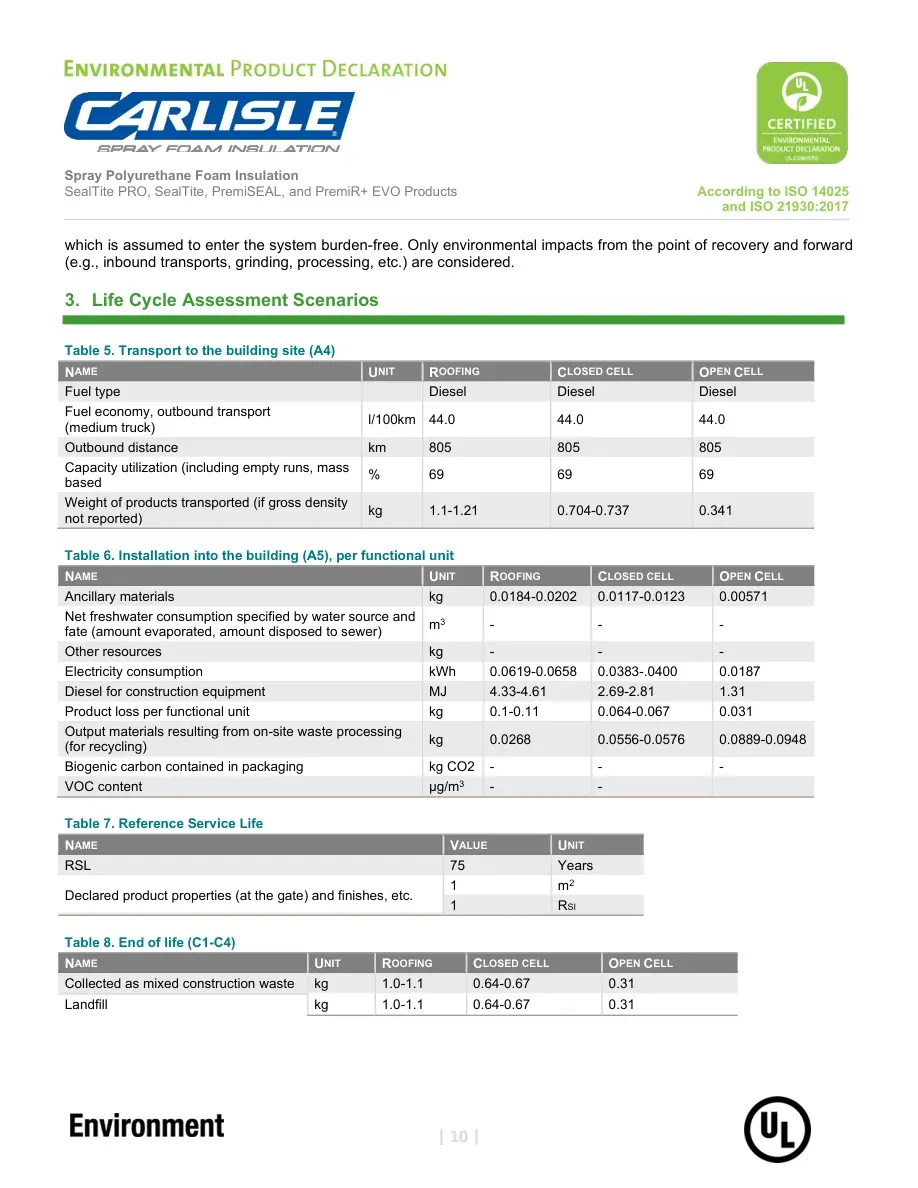
| 10 | Spray Polyurethane Foam Insulation SealTite PRO, SealTite, PremiSEAL, and PremiR+ EVO Products According to ISO 14025and ISO 21930:2017which is assumed to enter the system burden-free. Only environmental impacts from the point of recovery and forward (e.g., inbound transports, grinding, processing, etc.) are considered. 3. Life Cycle Assessment Scenarios Table 5. Transport to the building site (A4) NAME UNIT ROOFING CLOSED CELL OPEN CELL Fuel type Diesel Diesel Diesel Fuel economy, outbound transport (medium truck) l/100km 44.0 44.0 44.0 Outbound distance km 805 805 805 Capacity utilization (including empty runs, mass based % 69 69 69 Weight of products transported (if gross density not reported) kg 1.1-1.21 0.704-0.737 0.341 Table 6. Installation into the building (A5), per functional unit NAME UNIT ROOFING CLOSED CELL OPEN CELL Ancillary materials kg 0.0184-0.0202 0.0117-0.0123 0.00571 Net freshwater consumption specified by water source and fate (amount evaporated, amount disposed to sewer) m3 - - - Other resources kg - - - Electricity consumption kWh 0.0619-0.0658 0.0383-.0400 0.0187 Diesel for construction equipment MJ 4.33-4.61 2.69-2.81 1.31 Product loss per functional unit kg 0.1-0.11 0.064-0.067 0.031 Output materials resulting from on-site waste processing (for recycling) kg 0.0268 0.0556-0.0576 0.0889-0.0948 Biogenic carbon contained in packaging kg CO2 - - - VOC content μg/m3 - - Table 7. Reference Service Life NAME VALUE UNIT RSL 75 Years Declared product properties (at the gate) and finishes, etc. 1 m2 1 RSI Table 8. End of life (C1-C4) NAME UNIT ROOFING CLOSED CELL OPEN CELL Collected as mixed construction waste kg 1.0-1.1 0.64-0.67 0.31 Landfill kg 1.0-1.1 0.64-0.67 0.31
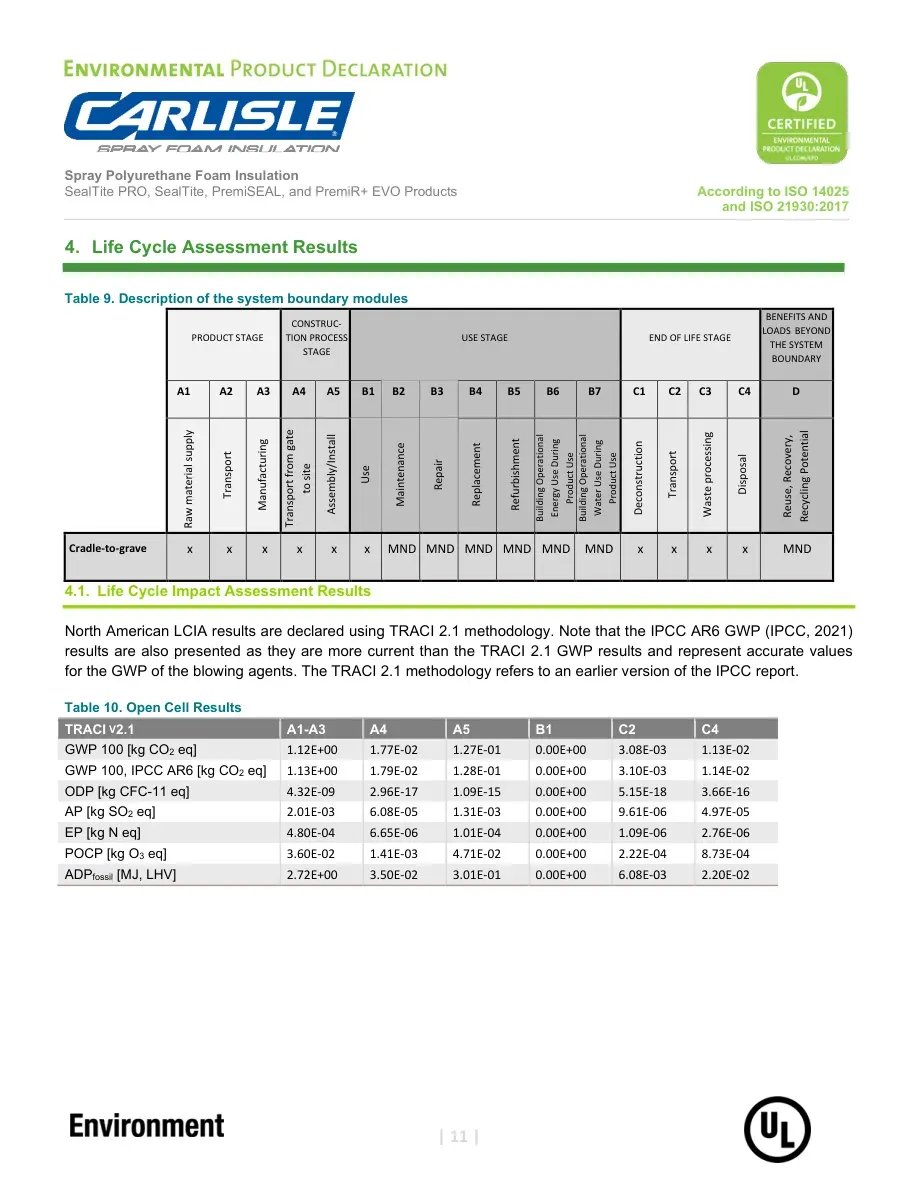
| 11 | Spray Polyurethane Foam Insulation SealTite PRO, SealTite, PremiSEAL, and PremiR+ EVO Products According to ISO 14025and ISO 21930:20174. Life Cycle Assessment Results Table 9. Description of the system boundary modules PRODUCT STAGE CONSTRUC- TION PROCESS STAGE USE STAGE END OF LIFE STAGE BENEFITS AND LOADS BEYOND THE SYSTEM BOUNDARY A1 A2 A3 A4 A5 B1 B2 B3 B4 B5 B6 B7 C1 C2 C3 C4 D Raw material supply Transport Manufacturing Transport from gate to site Assembly/Install Use Maintenance Repair Replacement Refurbishment Building Operational Energy Use During Product Use Building Operational Water Use During Product Use Deconstruction Transport Waste processing Disposal Reuse, Recovery, Recycling Potential Cradle-to-grave x x x x x x MND MND MND MND MND MND x x x x MND 4.1. Life Cycle Impact Assessment Results North American LCIA results are declared using TRACI 2.1 methodology. Note that the IPCC AR6 GWP (IPCC, 2021) results are also presented as they are more current than the TRACI 2.1 GWP results and represent accurate values for the GWP of the blowing agents. The TRACI 2.1 methodology refers to an earlier version of the IPCC report. Table 10. Open Cell Results TRACI V2.1 A1-A3 A4 A5 B1 C2 C4 GWP 100 [kg CO2 eq] 1.12E+00 1.77E-02 1.27E-01 0.00E+00 3.08E-03 1.13E-02 GWP 100, IPCC AR6 [kg CO2 eq] 1.13E+00 1.79E-02 1.28E-01 0.00E+00 3.10E-03 1.14E-02 ODP [kg CFC-11 eq] 4.32E-09 2.96E-17 1.09E-15 0.00E+00 5.15E-18 3.66E-16 AP [kg SO2 eq] 2.01E-03 6.08E-05 1.31E-03 0.00E+00 9.61E-06 4.97E-05 EP [kg N eq] 4.80E-04 6.65E-06 1.01E-04 0.00E+00 1.09E-06 2.76E-06 POCP [kg O3 eq] 3.60E-02 1.41E-03 4.71E-02 0.00E+00 2.22E-04 8.73E-04 ADPfossil [MJ, LHV] 2.72E+00 3.50E-02 3.01E-01 0.00E+00 6.08E-03 2.20E-02
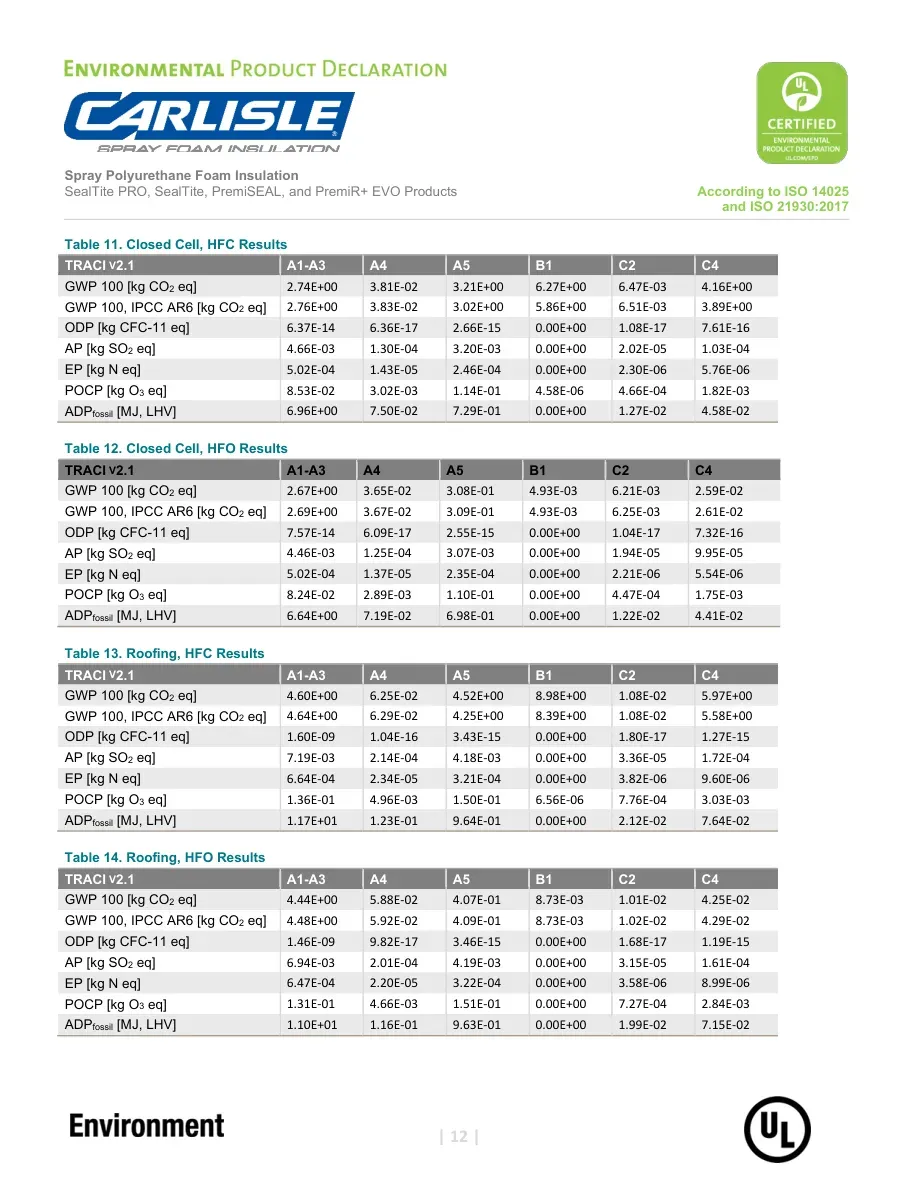
| 12 | Spray Polyurethane Foam Insulation SealTite PRO, SealTite, PremiSEAL, and PremiR+ EVO Products According to ISO 14025and ISO 21930:2017Table 11. Closed Cell, HFC Results TRACI V2.1 A1-A3 A4 A5 B1 C2 C4 GWP 100 [kg CO2 eq] 2.74E+00 3.81E-02 3.21E+00 6.27E+00 6.47E-03 4.16E+00 GWP 100, IPCC AR6 [kg CO2 eq] 2.76E+00 3.83E-02 3.02E+00 5.86E+00 6.51E-03 3.89E+00 ODP [kg CFC-11 eq] 6.37E-14 6.36E-17 2.66E-15 0.00E+00 1.08E-17 7.61E-16 AP [kg SO2 eq] 4.66E-03 1.30E-04 3.20E-03 0.00E+00 2.02E-05 1.03E-04 EP [kg N eq] 5.02E-04 1.43E-05 2.46E-04 0.00E+00 2.30E-06 5.76E-06 POCP [kg O3 eq] 8.53E-02 3.02E-03 1.14E-01 4.58E-06 4.66E-04 1.82E-03 ADPfossil [MJ, LHV] 6.96E+00 7.50E-02 7.29E-01 0.00E+00 1.27E-02 4.58E-02 Table 12. Closed Cell, HFO Results TRACI V2.1 A1-A3 A4 A5 B1 C2 C4 GWP 100 [kg CO2 eq] 2.67E+00 3.65E-02 3.08E-01 4.93E-03 6.21E-03 2.59E-02 GWP 100, IPCC AR6 [kg CO2 eq] 2.69E+00 3.67E-02 3.09E-01 4.93E-03 6.25E-03 2.61E-02 ODP [kg CFC-11 eq] 7.57E-14 6.09E-17 2.55E-15 0.00E+00 1.04E-17 7.32E-16 AP [kg SO2 eq] 4.46E-03 1.25E-04 3.07E-03 0.00E+00 1.94E-05 9.95E-05 EP [kg N eq] 5.02E-04 1.37E-05 2.35E-04 0.00E+00 2.21E-06 5.54E-06 POCP [kg O3 eq] 8.24E-02 2.89E-03 1.10E-01 0.00E+00 4.47E-04 1.75E-03 ADPfossil [MJ, LHV] 6.64E+00 7.19E-02 6.98E-01 0.00E+00 1.22E-02 4.41E-02 Table 13. Roofing, HFC Results TRACI V2.1 A1-A3 A4 A5 B1 C2 C4 GWP 100 [kg CO2 eq] 4.60E+00 6.25E-02 4.52E+00 8.98E+00 1.08E-02 5.97E+00 GWP 100, IPCC AR6 [kg CO2 eq] 4.64E+00 6.29E-02 4.25E+00 8.39E+00 1.08E-02 5.58E+00 ODP [kg CFC-11 eq] 1.60E-09 1.04E-16 3.43E-15 0.00E+00 1.80E-17 1.27E-15 AP [kg SO2 eq] 7.19E-03 2.14E-04 4.18E-03 0.00E+00 3.36E-05 1.72E-04 EP [kg N eq] 6.64E-04 2.34E-05 3.21E-04 0.00E+00 3.82E-06 9.60E-06 POCP [kg O3 eq] 1.36E-01 4.96E-03 1.50E-01 6.56E-06 7.76E-04 3.03E-03 ADPfossil [MJ, LHV] 1.17E+01 1.23E-01 9.64E-01 0.00E+00 2.12E-02 7.64E-02 Table 14. Roofing, HFO Results TRACI V2.1 A1-A3 A4 A5 B1 C2 C4 GWP 100 [kg CO2 eq] 4.44E+00 5.88E-02 4.07E-01 8.73E-03 1.01E-02 4.25E-02 GWP 100, IPCC AR6 [kg CO2 eq] 4.48E+00 5.92E-02 4.09E-01 8.73E-03 1.02E-02 4.29E-02 ODP [kg CFC-11 eq] 1.46E-09 9.82E-17 3.46E-15 0.00E+00 1.68E-17 1.19E-15 AP [kg SO2 eq] 6.94E-03 2.01E-04 4.19E-03 0.00E+00 3.15E-05 1.61E-04 EP [kg N eq] 6.47E-04 2.20E-05 3.22E-04 0.00E+00 3.58E-06 8.99E-06 POCP [kg O3 eq] 1.31E-01 4.66E-03 1.51E-01 0.00E+00 7.27E-04 2.84E-03 ADPfossil [MJ, LHV] 1.10E+01 1.16E-01 9.63E-01 0.00E+00 1.99E-02 7.15E-02
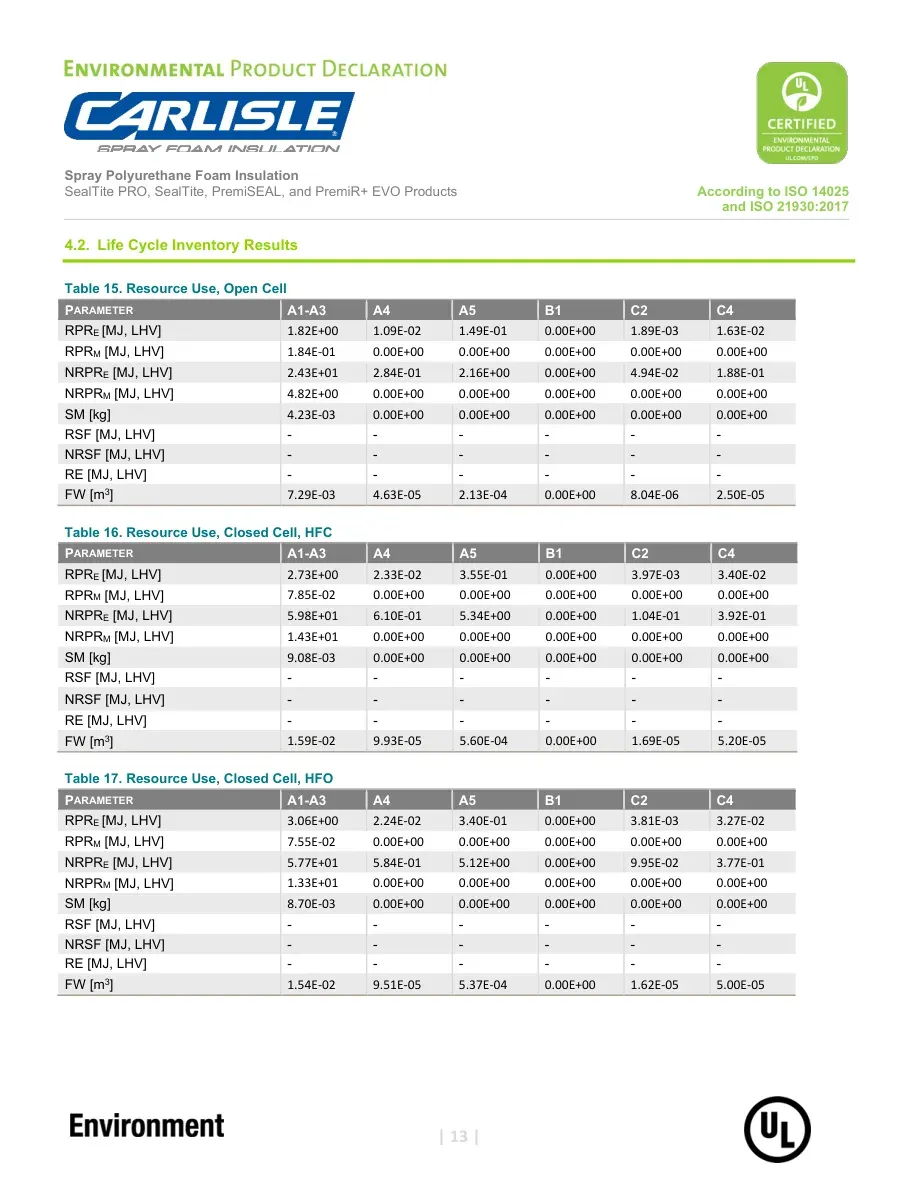
| 13 | Spray Polyurethane Foam Insulation SealTite PRO, SealTite, PremiSEAL, and PremiR+ EVO Products According to ISO 14025and ISO 21930:20174.2. Life Cycle Inventory Results Table 15. Resource Use, Open Cell PARAMETER A1-A3 A4 A5 B1 C2 C4 RPRE [MJ, LHV] 1.82E+00 1.09E-02 1.49E-01 0.00E+00 1.89E-03 1.63E-02 RPRM [MJ, LHV] 1.84E-01 0.00E+00 0.00E+00 0.00E+00 0.00E+00 0.00E+00 NRPRE [MJ, LHV] 2.43E+01 2.84E-01 2.16E+00 0.00E+00 4.94E-02 1.88E-01 NRPRM [MJ, LHV] 4.82E+00 0.00E+00 0.00E+00 0.00E+00 0.00E+00 0.00E+00 SM [kg] 4.23E-03 0.00E+00 0.00E+00 0.00E+00 0.00E+00 0.00E+00 RSF [MJ, LHV] - - - - - - NRSF [MJ, LHV] - - - - - - RE [MJ, LHV] - - - - - - FW [m3] 7.29E-03 4.63E-05 2.13E-04 0.00E+00 8.04E-06 2.50E-05 Table 16. Resource Use, Closed Cell, HFC PARAMETER A1-A3 A4 A5 B1 C2 C4 RPRE [MJ, LHV] 2.73E+00 2.33E-02 3.55E-01 0.00E+00 3.97E-03 3.40E-02 RPRM [MJ, LHV] 7.85E-02 0.00E+00 0.00E+00 0.00E+00 0.00E+00 0.00E+00 NRPRE [MJ, LHV] 5.98E+01 6.10E-01 5.34E+00 0.00E+00 1.04E-01 3.92E-01 NRPRM [MJ, LHV] 1.43E+01 0.00E+00 0.00E+00 0.00E+00 0.00E+00 0.00E+00 SM [kg] 9.08E-03 0.00E+00 0.00E+00 0.00E+00 0.00E+00 0.00E+00 RSF [MJ, LHV] - - - - - - NRSF [MJ, LHV] - - - - - - RE [MJ, LHV] - - - - - - FW [m3] 1.59E-02 9.93E-05 5.60E-04 0.00E+00 1.69E-05 5.20E-05 Table 17. Resource Use, Closed Cell, HFO PARAMETER A1-A3 A4 A5 B1 C2 C4 RPRE [MJ, LHV] 3.06E+00 2.24E-02 3.40E-01 0.00E+00 3.81E-03 3.27E-02 RPRM [MJ, LHV] 7.55E-02 0.00E+00 0.00E+00 0.00E+00 0.00E+00 0.00E+00 NRPRE [MJ, LHV] 5.77E+01 5.84E-01 5.12E+00 0.00E+00 9.95E-02 3.77E-01 NRPRM [MJ, LHV] 1.33E+01 0.00E+00 0.00E+00 0.00E+00 0.00E+00 0.00E+00 SM [kg] 8.70E-03 0.00E+00 0.00E+00 0.00E+00 0.00E+00 0.00E+00 RSF [MJ, LHV] - - - - - - NRSF [MJ, LHV] - - - - - - RE [MJ, LHV] - - - - - - FW [m3] 1.54E-02 9.51E-05 5.37E-04 0.00E+00 1.62E-05 5.00E-05
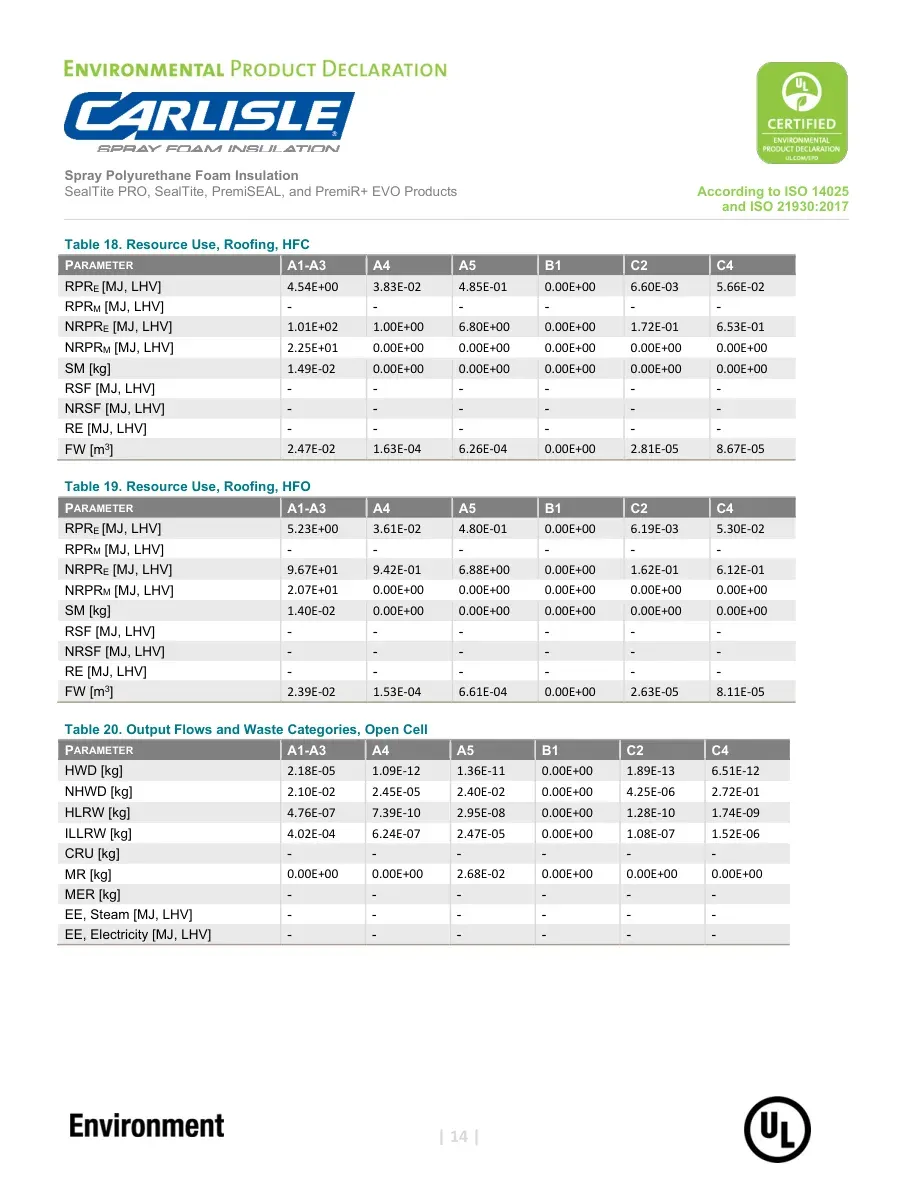
| 14 | Spray Polyurethane Foam Insulation SealTite PRO, SealTite, PremiSEAL, and PremiR+ EVO Products According to ISO 14025and ISO 21930:2017Table 18. Resource Use, Roofing, HFC PARAMETER A1-A3 A4 A5 B1 C2 C4 RPRE [MJ, LHV] 4.54E+00 3.83E-02 4.85E-01 0.00E+00 6.60E-03 5.66E-02 RPRM [MJ, LHV] - - - - - - NRPRE [MJ, LHV] 1.01E+02 1.00E+00 6.80E+00 0.00E+00 1.72E-01 6.53E-01 NRPRM [MJ, LHV] 2.25E+01 0.00E+00 0.00E+00 0.00E+00 0.00E+00 0.00E+00 SM [kg] 1.49E-02 0.00E+00 0.00E+00 0.00E+00 0.00E+00 0.00E+00 RSF [MJ, LHV] - - - - - - NRSF [MJ, LHV] - - - - - - RE [MJ, LHV] - - - - - - FW [m3] 2.47E-02 1.63E-04 6.26E-04 0.00E+00 2.81E-05 8.67E-05 Table 19. Resource Use, Roofing, HFO PARAMETER A1-A3 A4 A5 B1 C2 C4 RPRE [MJ, LHV] 5.23E+00 3.61E-02 4.80E-01 0.00E+00 6.19E-03 5.30E-02 RPRM [MJ, LHV] - - - - - - NRPRE [MJ, LHV] 9.67E+01 9.42E-01 6.88E+00 0.00E+00 1.62E-01 6.12E-01 NRPRM [MJ, LHV] 2.07E+01 0.00E+00 0.00E+00 0.00E+00 0.00E+00 0.00E+00 SM [kg] 1.40E-02 0.00E+00 0.00E+00 0.00E+00 0.00E+00 0.00E+00 RSF [MJ, LHV] - - - - - - NRSF [MJ, LHV] - - - - - - RE [MJ, LHV] - - - - - - FW [m3] 2.39E-02 1.53E-04 6.61E-04 0.00E+00 2.63E-05 8.11E-05 Table 20. Output Flows and Waste Categories, Open Cell PARAMETER A1-A3 A4 A5 B1 C2 C4 HWD [kg] 2.18E-05 1.09E-12 1.36E-11 0.00E+00 1.89E-13 6.51E-12 NHWD [kg] 2.10E-02 2.45E-05 2.40E-02 0.00E+00 4.25E-06 2.72E-01 HLRW [kg] 4.76E-07 7.39E-10 2.95E-08 0.00E+00 1.28E-10 1.74E-09 ILLRW [kg] 4.02E-04 6.24E-07 2.47E-05 0.00E+00 1.08E-07 1.52E-06 CRU [kg] - - - - - - MR [kg] 0.00E+00 0.00E+00 2.68E-02 0.00E+00 0.00E+00 0.00E+00 MER [kg] - - - - - - EE, Steam [MJ, LHV] - - - - - - EE, Electricity [MJ, LHV] - - - - - -
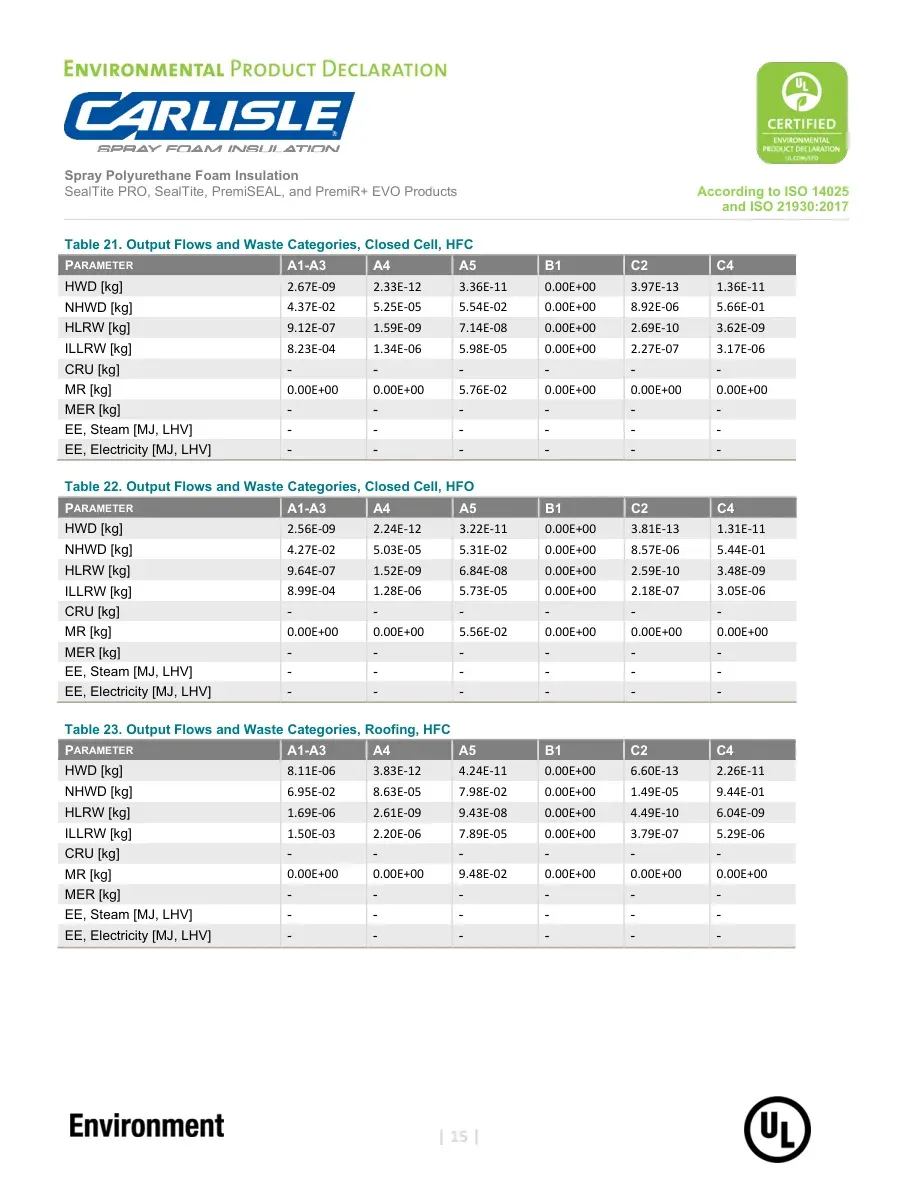
| 15 | Spray Polyurethane Foam Insulation SealTite PRO, SealTite, PremiSEAL, and PremiR+ EVO Products According to ISO 14025and ISO 21930:2017Table 21. Output Flows and Waste Categories, Closed Cell, HFC PARAMETER A1-A3 A4 A5 B1 C2 C4 HWD [kg] 2.67E-09 2.33E-12 3.36E-11 0.00E+00 3.97E-13 1.36E-11 NHWD [kg] 4.37E-02 5.25E-05 5.54E-02 0.00E+00 8.92E-06 5.66E-01 HLRW [kg] 9.12E-07 1.59E-09 7.14E-08 0.00E+00 2.69E-10 3.62E-09 ILLRW [kg] 8.23E-04 1.34E-06 5.98E-05 0.00E+00 2.27E-07 3.17E-06 CRU [kg] - - - - - - MR [kg] 0.00E+00 0.00E+00 5.76E-02 0.00E+00 0.00E+00 0.00E+00 MER [kg] - - - - - - EE, Steam [MJ, LHV] - - - - - - EE, Electricity [MJ, LHV] - - - - - - Table 22. Output Flows and Waste Categories, Closed Cell, HFO PARAMETER A1-A3 A4 A5 B1 C2 C4 HWD [kg] 2.56E-09 2.24E-12 3.22E-11 0.00E+00 3.81E-13 1.31E-11 NHWD [kg] 4.27E-02 5.03E-05 5.31E-02 0.00E+00 8.57E-06 5.44E-01 HLRW [kg] 9.64E-07 1.52E-09 6.84E-08 0.00E+00 2.59E-10 3.48E-09 ILLRW [kg] 8.99E-04 1.28E-06 5.73E-05 0.00E+00 2.18E-07 3.05E-06 CRU [kg] - - - - - - MR [kg] 0.00E+00 0.00E+00 5.56E-02 0.00E+00 0.00E+00 0.00E+00 MER [kg] - - - - - - EE, Steam [MJ, LHV] - - - - - - EE, Electricity [MJ, LHV] - - - - - - Table 23. Output Flows and Waste Categories, Roofing, HFC PARAMETER A1-A3 A4 A5 B1 C2 C4 HWD [kg] 8.11E-06 3.83E-12 4.24E-11 0.00E+00 6.60E-13 2.26E-11 NHWD [kg] 6.95E-02 8.63E-05 7.98E-02 0.00E+00 1.49E-05 9.44E-01 HLRW [kg] 1.69E-06 2.61E-09 9.43E-08 0.00E+00 4.49E-10 6.04E-09 ILLRW [kg] 1.50E-03 2.20E-06 7.89E-05 0.00E+00 3.79E-07 5.29E-06 CRU [kg] - - - - - - MR [kg] 0.00E+00 0.00E+00 9.48E-02 0.00E+00 0.00E+00 0.00E+00 MER [kg] - - - - - - EE, Steam [MJ, LHV] - - - - - - EE, Electricity [MJ, LHV] - - - - - -
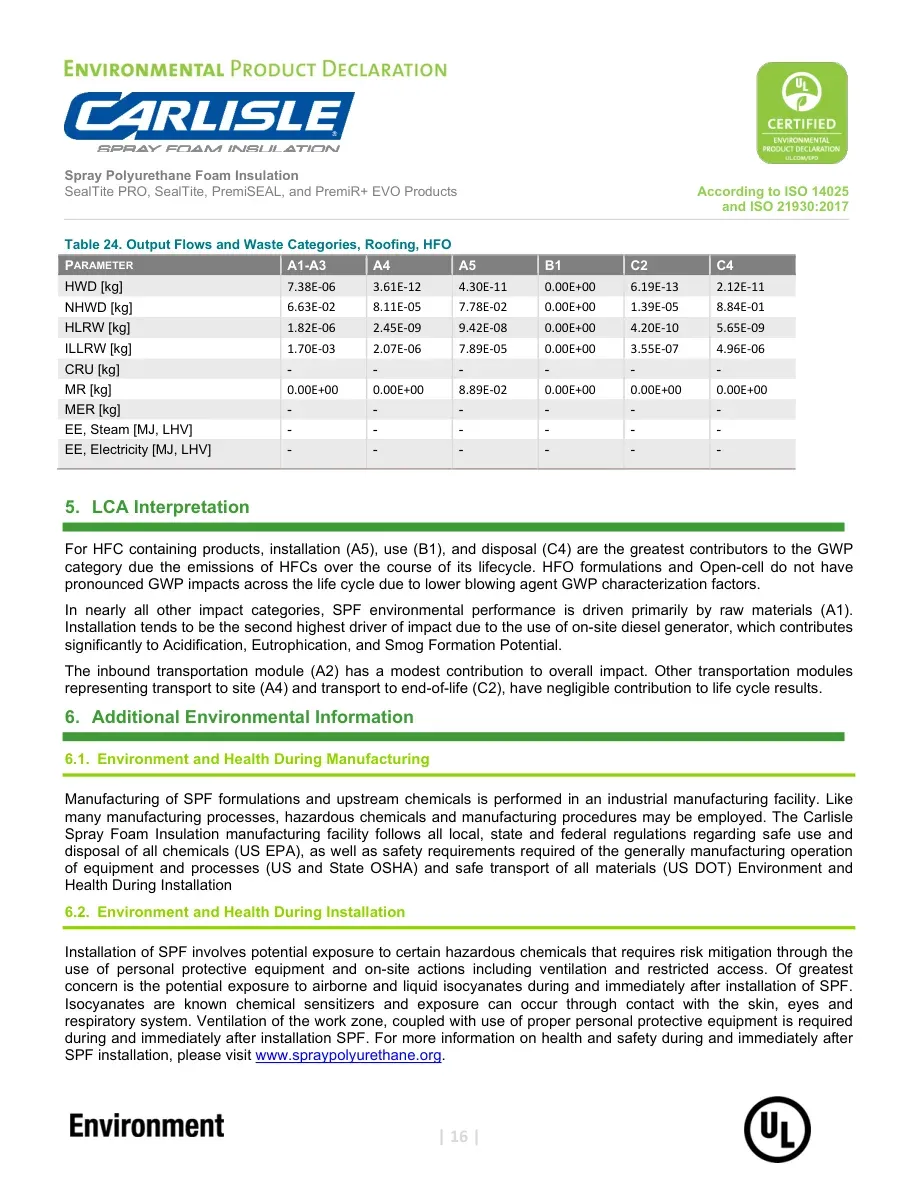
| 16 | Spray Polyurethane Foam Insulation SealTite PRO, SealTite, PremiSEAL, and PremiR+ EVO Products According to ISO 14025and ISO 21930:2017Table 24. Output Flows and Waste Categories, Roofing, HFO PARAMETER A1-A3 A4 A5 B1 C2 C4 HWD [kg] 7.38E-06 3.61E-12 4.30E-11 0.00E+00 6.19E-13 2.12E-11 NHWD [kg] 6.63E-02 8.11E-05 7.78E-02 0.00E+00 1.39E-05 8.84E-01 HLRW [kg] 1.82E-06 2.45E-09 9.42E-08 0.00E+00 4.20E-10 5.65E-09 ILLRW [kg] 1.70E-03 2.07E-06 7.89E-05 0.00E+00 3.55E-07 4.96E-06 CRU [kg] - - - - - - MR [kg] 0.00E+00 0.00E+00 8.89E-02 0.00E+00 0.00E+00 0.00E+00 MER [kg] - - - - - - EE, Steam [MJ, LHV] - - - - - - EE, Electricity [MJ, LHV] - - - - - - 5. LCA InterpretationFor HFC containing products, installation (A5), use (B1), and disposal (C4) are the greatest contributors to the GWP category due the emissions of HFCs over the course of its lifecycle. HFO formulations and Open-cell do not have pronounced GWP impacts across the life cycle due to lower blowing agent GWP characterization factors. In nearly all other impact categories, SPF environmental performance is driven primarily by raw materials (A1). Installation tends to be the second highest driver of impact due to the use of on-site diesel generator, which contributes significantly to Acidification, Eutrophication, and Smog Formation Potential. The inbound transportation module (A2) has a modest contribution to overall impact. Other transportation modules representing transport to site (A4) and transport to end-of-life (C2), have negligible contribution to life cycle results. 6. Additional Environmental Information6.1. Environment and Health During Manufacturing Manufacturing of SPF formulations and upstream chemicals is performed in an industrial manufacturing facility. Like many manufacturing processes, hazardous chemicals and manufacturing procedures may be employed. The Carlisle Spray Foam Insulation manufacturing facility follows all local, state and federal regulations regarding safe use and disposal of all chemicals (US EPA), as well as safety requirements required of the generally manufacturing operation of equipment and processes (US and State OSHA) and safe transport of all materials (US DOT) Environment and Health During Installation 6.2. Environment and Health During Installation Installation of SPF involves potential exposure to certain hazardous chemicals that requires risk mitigation through the use of personal protective equipment and on-site actions including ventilation and restricted access. Of greatest concern is the potential exposure to airborne and liquid isocyanates during and immediately after installation of SPF. Isocyanates are known chemical sensitizers and exposure can occur through contact with the skin, eyes and respiratory system. Ventilation of the work zone, coupled with use of proper personal protective equipment is required during and immediately after installation SPF. For more information on health and safety during and immediately after SPF installation, please visit www.spraypolyurethane.org.
| 17 | Spray Polyurethane Foam Insulation SealTite PRO, SealTite, PremiSEAL, and PremiR+ EVO Products According to ISO 14025and ISO 21930:20176.3. Extraordinary Effects Fire Spray polyurethane foam, like all foam plastics and many construction materials – including wood - is a combustible material and will emit toxic gases including carbon monoxide during a fire. When used in buildings and other construction applications, foam plastics employ flame retardants to control ignition the spread of fire and development of smoke. In addition, foam plastics may need to be protected with fire-resistant coverings or coatings when used in certain construction applications, as dictated by the building codes. All foam plastics materials and assemblies should meet the fire test requirements of the applicable building codes. Water The closed-cell and roofing SPF products meet the FEMA Class 5 requirements1 for flood-damage resistant insulation materials for floors and walls. Mechanical Destruction Should the assembly the SPF is installed in, i.e. the wall or roof, have to be replaced then the SPF will have to be replaced as well. 6.4. Delayed Emissions This study assumes 16% of the original physical blowing agent is emitted at end of life. It is further assumed the spray foam is inert in the landfill and 50% of the blowing agent remains in the product after disposal. (Honeywell International) 6.5. Environmental Activities and Certifications CSFI has certified or tested its insulation products to various VOC standards to measure emissions of volatile or semi-volatile compounds. These standards include: –UL Environment GREENGUARD® Certification – The GREENGUARD® Certification Program specifies strictcertification criteria for VOC's and indoor air quality. This voluntary program helps consumers identify productsthat have low chemical emissions for improved indoor air quality.–California Department of Health Services – Also known as Section 01350, this small-chamber emissions teststandard is detailed under: Standard Practice for the Testing of Volatile Organic Emissions from VariousSources Using Small-Scale Environmental Chambers (CA/DHS/EHLB/Standard Method v1.1-2010).–Canadian ULC – Required for SPF insulation products, this standard provides a similar VOC emissions testprotocol specifically for SPF: CAN/ULC S774-09 Standard Laboratory Guide for the Determination of VolatileOrganic Compound Emissions from Polyurethane Foam–Currently, an ASTM workgroup is developing a small-chamber emissions test protocol for chemicalcompounds specific to SPF that include MDI, blowing agents, flame retardants and catalysts.1 “Flood Damage-Resistant Materials Requirements”, FEMA Technical Bulletin 2, 2008, Table 2.
| 18 | Spray Polyurethane Foam Insulation SealTite PRO, SealTite, PremiSEAL, and PremiR+ EVO Products According to ISO 14025and ISO 21930:20176.6. Further Information This EPD is based on LCAs of SPF products that use HFCs and HFOs as blowing agents. Because of the low global warming potential factor of HFOs (~1.0 g CO2-eq./kg) the emissions of these blowing agents account for a small percentage of the global warming potential life cycle results for HFO containing foams. Despite being released at the same rate over the course of the life of the product as HFOs, HFCs have a substantially higher contribution to GWP due to their GWP characterization factor of HFC-134a and HFC-245fa (1,300 and 858 kg CO2-eq./kg, respectively, over a 100 year time horizon (IPCC, 2021))2. 7. ReferencesEN 15804: Sustainability of construction works, Environmental product declarations, Core rules for the product category of construction products. (2013). European Committee for Standardization. EPA. (2012). Tool for the Reduction and Assessment of Chemical and other Environmental Impacts (TRACI) - User's Manual. Washington, D.C.: US EPA. Honeywell International. (n.d.). Predictive Model for Polyurethane Blowing Agent Emissions into a House. Buffalo. IPCC. (2021). Climate Change 2021: The Physical Science Basis. Contribution of Working Group I to the Sixth Assessment Report of the Intergovernmental Panel on Climate Change doi:10.1017/9781009157896. ISO. (2006). ISO 14025: Environmental labels and declarations - Type III environmental declarations - Principles and procedures. Geneva: International Organization for Standardization. ISO. (2020a). ISO 14040/Amd.1:2020: Environmental management - Life cycle assessment - Principles and Framework. Geneva: International Organization for Standardization. ISO. (2020b). ISO 14044:2006/Amd.1:2017/Amd.2:2020: Environmental management - Life cycle assessment - Requirements and Guidelines. Geneva: International Organization for Standardization. ISO. (2017). ISO 21930: Sustainability in building construction - Environmental declaration of building products. Geneva: International Organization for Standardization. Kjeldsen, P., & Jensen, M. (2001). Release of CFC-11 from Disposal of Polyurethane Foam Waste. ENVIRONMENTAL SCIENCE & TECHNOLOGY, 3055-3063. SPFA. (2018). Environmental Product Declaration: Spray Polyurethane Foam Insulation. ASTM. Sphera. (2022). GaBi LCA Database Documentation. Retrieved from Sphera Solutions, Inc.: http://www.gabi-software.com/america/support/gabi/ UL Environment. (2018). Product Category Rules (PCR) Guidance for Building-Related Products and Services Part B: Building Envelope Thermal Insulation EPD Requirements, UL 10010–1 (v2.0). UL Environment. (2018). Product Category Rules for Building-Related Products and Services - Part A: Life Cycle Assessment Calculation Rules and Report Requirements, UL 10010 (v3.2). UL Environment (2020). Program Operator Rules v2.5 2 Note that the TRACI 2.1 GWP methodology uses an earlier version of the IPCC report where the characterization factors of HFC-134a and HFC-245fa are 1,430 and 1,030 kg CO2-eq./kg, respectively.